|
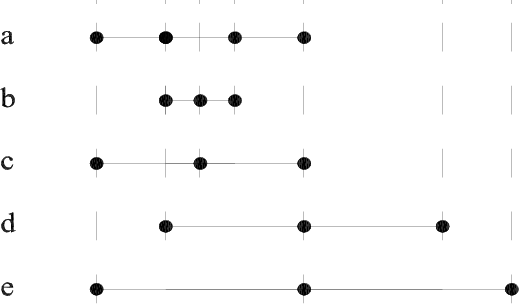
According to our theory, the anticipation hierarchies are iso-regular groups and complexity in a work will break the iso-regularity, and thus break the anticipated structure. This is a fundamentally important concept: Breaking the anticipation hierarchy is equivalent to breaking the iso-regular group: Breaking the anticipation hierarchy. Most crucially, our theory says that breaking the iso-regular group must itself be achieved by transfer; i.e., broken iso-regularity must be perceived as the transfer of iso-regularity. Thus, since the iso-regular components are loaded into the alignment kernel, the breaking is carried out by adding control groups above the alignment kernel which will selectively deform and move the iso-regular components. To illustrate, let us return to meter. Mazzola (1993-1996, 2002) invented the important concept of a local meter atlas. This is the covering of an irregular pattern by local regular meters. To illustrate, observe that, in figure 18, the melody has an irregular structure of onsets, as shown in line X of the diagram. Below this, the lines marked a-e are each regular meters that cover the onsets in the above irregular pattern. These local meters are maximal in the sense that they extend the furthest distance allowed by the onsets in the irregular pattern. Nestke and Noll (2001) and Fleischer and Noll (2002) call these, inner local meters, to distinguish them from the meter structure determined by the time-signature of the score; i.e., corresponding to the conventional hierarchy of beat accents associated with the bar-lines, etc. The accent structure corresponding to the time-signature is called the outer meter structure. Using this theory, extensive and insightful analyses have been developed by Mazzola (2002), Fleischer et al. (2000), Fleischer and Noll (2002). What we do now is propose a generative theory of the local meter atlas. To illustrate, return to figure 18. Recall that lines a-e in that diagram give the inner local meters. Notice that they all correspond to iso-regular groups (each with an occupancy subgroup). What we argue is that the atlas, i.e., arrangement of these groups, was generated from a starting state in which these iso-regular groups were maximally aligned, and that the subsequent generative process misaligned those groups. That is, the atlas is the misaligned version of the alignment kernel. The misalignments were created by wreath-appending control groups above the alignment kernel that selectively deformed and moved the iso-regular groups that comprised the alignment kernel. Notice that one can regard the ultimate reference object within the alignment kernel - i.e., the ultimate parent in the inheritance hierarchy defined by the control groups - as the metric structure given by the time signature.
Our musical theory is therefore mathematically equivalent to our theory of mechanical CAD. To see this crucial similarity, consider the following example of an unfolding group: ![[G1 ×G2 × G3] wO AGL(3, R) wO AGL(3, R).](../graphic/Co2579x.gif) The fiber |

![[G1× G2 × G3]](../graphic/Co2580x.gif) is the direct product of iso-regular groups; and the copy of this fiber, corresponding to the identity element in the full control group, is the
is the direct product of iso-regular groups; and the copy of this fiber, corresponding to the identity element in the full control group, is the