Thus, the complete problem ( voices, with several onsets by voice) is equivalent to solve the fllowing system. We note
  the Bezout coefficient of
  with
with  , ie
, ie  .
.

2.1.3 Spectral chords
This problem has been given by the french composer Fabien Lévy. We want to find spectral chords with the same number  of notes, which share a fixed number of notes
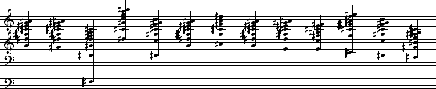
  from one to another. A solution is shown figure 2.
The usual representation in MIDI values is not suitable for this problem, because it adds constraints to represent the spectral structure of the chords. The  -th chords
  will thus be represented with its fundamental
  , interval
  , the number of the lower partial
  and the number of notes
  (the latter parameters could be changed for the ambitus, but this doesn’t guarantee the number of notes). With this representation, the chord is the set
  .
.
The constraint states that  . To avoid trivial solutions (always the same chord, or solution of type
  ), we add a constraint
  .
.
Fabien Lévy defined several variation on this idea. Firstly, the number  can be given as a frame
 ![[m ...M ]](../graphic/Co4649x.gif) , changing the first constraint
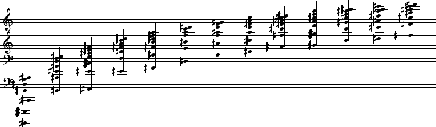
, changing the first constraint  . Secondly, we can enforce this constraint by stating that all the chords share the same common note(s), as shown figure 3. Finally, we can add a constraint to determine the global move of the whole sequence, stretching or contracting the chords (adds a constraint
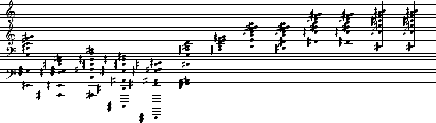
  , resp. >), or making them move upward or downward (adds a constraint
  , resp. >), see figure 4.
2.1.4 Gestures
This problem has been given by the french composer Gilbert Nouno (in Droben, by Michaël Jarrell, for double bass, ensemble and electronics). The goal is to find a melody with both intervals and notes in fixed domains. Notice the sort of
 common notes.