8.1, each such sequence can be folded to a sequence

of real numbers. This yields the

required vectors

.
8.6 Colimit
In order to describe the colimit folding map for presheaf topoi, it is well known (Mac Lane, 1971) that one may restrict to coproducts and then apply an equivalence relation to this folding result. This time, the form is a coproduct  . The denotator
  is the disjoint union of the
  sub-denotators
  which live in
  . Each such denotator is by recursion folded to an increasing sequence
  (order preservation is reflected in this structure!) of real numbers by a default
  folder matrix in
  as above. In order to distinguish globally (over all cofactors) these numerical values, we decompose the given folder matrix
  into monotony sequences. The first such sequence
  starts with the first column and goes on until the first
  entry appears with lower row index than the preceding column. Then starts the second monotony sequence
  , and so on, until the last monotony sequence
  . In each monotony sequence, we have subsequences of constant row index
  for their
  entry. So each constant row sequence is indexed by the index
  of the monotony sequence and the index
  of the row in question. Within such a sequence, we have a numbering of the cofactors with positive indices
  in the integer interval
  . Therefore, in the row sequence of index
  , we have the values
  in 2-space of folded cofactor denotators as given by the above recursively calculated sequences
  . The 2D folding algorithm yields corresponding real numbers
  , and we obtain an array of 3-space vectors
  , which yields the desired order preserving representation of
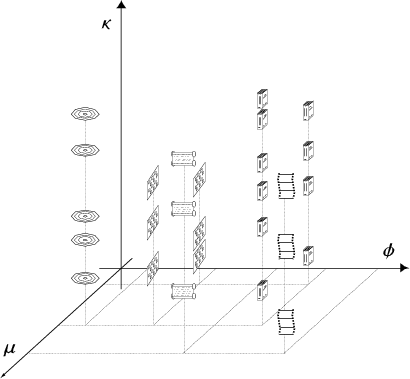
  . Intuitively, this situation is given for a collection of objects from an number of spaces, such as a set of signs in books, CDs, LPs, etc. The folder matrix creates a number of stacks of such books and distributes the folded book contents over a “library in 3-space”, see figure 6 for an illustration.
8.7 Powerset
The most natural way to deal with a powerset denotator is to view it as the collection or “container” of its elements and to proceed by folding one element after the other recursively with respect to their type. (Note that all elements of the powerset are of the same type.) We call this powerset disclosure. The preceding folding of limit and colimit denotator collections were special cases of this general situation. However, the “powerset of powerset” case is somewhat special: Here we represent the elements in a  array, we use their position in their canonically ordered arrangement as first and their barycenter-value as second coordinate. This arrangement is then folded with the
  folding matrix. Logically there is also an undisclosed way of folding a powerset denotator. In this case the barycenters of the
  elements are folded with the standard
  folding matrix. This undisclosed folding is the default case if a powerset denotator is itself a (co-)factor of an element of another denotator.