|
coherence does not apply to the second part of the metric weight in figure 5. This part is characterized by a completely different regularity (see also a detailed version in figure 6), which corresponds to the outer accent hierarchy of  instead of the notated instead of the notated  , as shown in figure 9. Hence metric coherence cannot be stated. The last part of the metric weight in figure 7 again reveals very different regularities. One may distinguish layers, but in contrast to the second part, within the highest layer no periodic differentiation can be stated. Therefore metric coherence cannot be found. , as shown in figure 9. Hence metric coherence cannot be stated. The last part of the metric weight in figure 7 again reveals very different regularities. One may distinguish layers, but in contrast to the second part, within the highest layer no periodic differentiation can be stated. Therefore metric coherence cannot be found. Inner metric analysis hence suggests a segmentation of the exposition into three parts. These parts interestingly correspond to a segmentation of the exposition based on a harmonic point of view, as suggested by Graham Phipps8
Now we go into more detail concerning these three parts of diverse inner metric structures within the metric weight of the entire exposition.
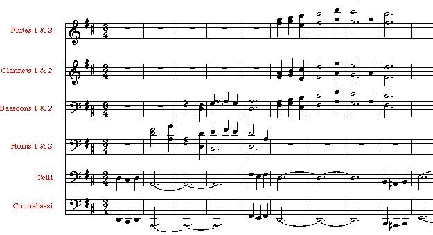
Concerning the first part of the exposition (Epstein, 1987) states an ambiguity regarding the mutual relationship of the first two measures of the movement (see figure 8): »Should they be heard as tonic or dominant oriented? Is the first measure upbeat or downbeat?«9 This ambiguity is important not only regarding the first two measures since it influences the following parts of the movement as well: »Both its harmonic and rhythmic properties are unclear and capable of producing various viewpoints, many of which are explored as the music progresses.«10According to Epstein, the harmonic and rhythmic properties do not allow an unequivocal decision concerning the relation of up- and downbeat within the first |