|
Since the hemiolas are located at the edges of the segment of the measures 42-81 the question arises, whether they are mainly responsible for the divergence between inner and outer metric structure within this great segment. This conjecture is tested by excluding these edges of the measures 42-43 and 78-81, figure 12 shows the result of the corresponding analysis for the measures 44-77. Obviously this metric weight reveals a very different shape and is not characterized by the periodicity corresponding to time signature The metric weight in figure 12 concerning the measures 44-59 (the first part before the caesura in the middle of the figure) does not show layers corresponding to the >strong< and >weak< beats of the time signature Hence the metric weight of the measures 44-77 is characterized on the one hand by an ambiguity between
Both characteristics correspond to observations in Epstein (1987). The following quotation concerns the great metric weights on the third beats: »As the big D major section after measure 44 develops to a climax at measure 59, the rhythmic nature of the motive is again unclear. It appears at measure 59 with great downbeat force - the resolution of a long dominant passage, further intensified by a crescendo. However, its attack is on the third beat of |
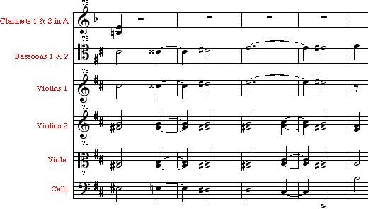
 . Hence the observed periodicity within the segment of measures 44-78 in figure
  , since the second and fifth eighths gain the greatest metric weights in most cases. Hence by shifting the bar line (see figure
  can be observed in the section before the caesura: first and fourth beats get the greatest weights. The metric weight in figure
  , whereas in other measures great metric weights on the fourth eighths prevent the occurrence of these layers. The evaluation of this segment in figure
  and
and  and on the other by a great metric weight on the third instead of the first beat.
