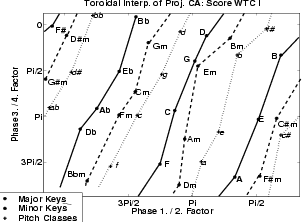
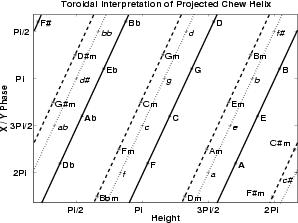
Consistency with a Geometric Model (Chew, 2000). It is fruitful to compare the toroidal interpretation (upper Figure 6) of the biplot of keys and pitch classes (lower Figure 3) with Chew (2000) (middle Figure 6). In Chew (2000) heterogeneous musical quantities, namely, tones, chords, and keys are embedded in a three-dimensional space, thereby visualizing their inter relations (cf. Appendix 6.2 for technical details). The model is derived from the tonnetz (Euler, 1926; Lewin, 1987). Tones are lined up on a helix along the circle of fifths, circular in the X-Y-plane and elevating in the Z direction. For a triad composed of three tones, construct the triangle whose vertices are given by the tones constituting the triad. Then the triad is represented by the weighted center of gravity of the triangle. In the same way a key is represented as the center of gravity of the triangle whose vertices are the points given by the three main triads (tonic, dominant, subdominant) of the key. We reduce this model to pitch classes and keys, assuming that the intermediate level of chords is implicitly given in the music. Chew (2000) gives a set of parameters derived by optimization techniques from musically meaningful constraints. We choose a different set of parameters to fit the |