|
the intensities of each pitch class accumulated for each of the 24 Fugues in all 24 Major and minor keys (Figure 1). Pitch classes are represented by 24-dimensional key intensity vectors. In the same way as in Section 3.1, in correspondence analysis a singular value decomposition is performed yielding the factors as a new co-ordinate system. As in middle Figure 3, the pitch class vectors are projected onto a two-dimensional plane, spanned by the two most prominent factors. The circle of fifths evolves in pitch classes embedded in the keyspace in performance data as well. The two factors of performed WTC II (lower Figure 7) capture an even higher percentage (88.54 %) of the variance of the data, than those for the score data of WTC I (cf. Figure 5). Both factors are high and almost equal. Therefore the two-dimensional projection appears to be a very appropriate representation of pitch classes. Comparisons have been made with other cycles of musical pieces like Chopin’s Préludes Op. 28 and Hindemith’s »ludus tonalis«: In these cycles one singular value alone is by far most prominent. That means that key frequency space as well as pitch class space can be reduced to one dimension still being able to explain the majority of the data.
|
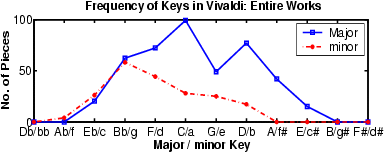
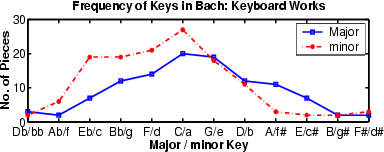
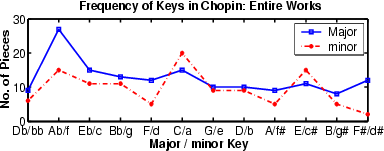
 -Major,B-Major, A
 -Major, c
 -minor, g
 -minor, b
 -minor.
  of the pieces are written in a Major key. The most frequent keys in Chopin are A
 -Major, a-minor, C-Major, E
 -Major, and c
 -minor. There are only two pieces in d
 -minor.
  of the pieces are in Major.