The entire bottom block in figure
1 can be considered to illustrate this direct product. Notice that the control group action of

on

induces an action of

on the set of indexes

within the direct product in (
4). Most crucially, this action of

is an
automorphic action on the direct product.
Next, take the semi-direct product of the entire lower block and the control group above, thus:
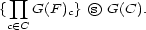 | (5) |
The lower block  is the normal subgroup of the semi-direct product. In any semi-direct product, the upper group acts as an automorphism group of the normal subgroup (here the lower block); and in this case the chosen automorphic action will be the one defined in the previous paragraph.
Next consider the set  , which we will call the data set. Notice that this set decomposes into the fiber-set copies
  .
.
Now for the final fundamental point concerning wreath products: There is a group action of the wreath product  on the data set
  . To define this action, let us assume, only for the purposes of notation, that the control set
  is finite, of cardinality
  . Observe that, by the semi-direct product structure of the wreath product (as shown in expression (5)), a single element from the wreath product must be of the form:
 | (6) |
where each  is an element taken from its fiber-group copy
  (column in figure 1); and
  is an element taken from the control group (upper level in figure 1).
Let us therefore see the effect of the full element in expression (6) on a single point  in the data set
  . Notice, since each
  in expression (6) acts only on its personal fiber-set copy, only the element
  will act on the point
  . It sends it to the point
  . Finally, the element
  in expression (6) moves this point to its corresponding position in the fiber indexed by
  .
.
The action will be called the full wreath action, and we have seen that it is given thus:
![{ G(F)wOG(C) × [F × C] - --> [F × C] ( < ( Tc1 , Tc2 , ... , Tcn )| g > , (f,ci) ) '- --> (Tcif,gci).](../graphic/Co2282x.gif) | (7) |
7 Mathematical Theory of Transfer
We are now ready to give our rigorous theory of transfer, as follows: Each copy  , of the fiber group, acts on its own copy of the fiber set
  . One can view the control group as transferring the fiber-group copies around the fiber-set copies. In fact, this action is achieved by the automorphic action of the control group within the wreath product, as given by the map
  . This action sends the fiber-group copies onto each other via conjugation. Therefore: