|
Mathematical Structure of Transfer. Transfer will be modelled by the conjugacy action of the control group on the fiber-group copies within a wreath product.
8 Theory of GestaltA musical work is structured by perceptual organization - often referred to as Gestalt organization. In Leyton (1984), Leyton (1986a), Leyton (1986b), Leyton (1986c), Leyton (1987), Leyton (1992), I put forward several hundred pages of psychological evidence that lead to the following theory of Gestalt:
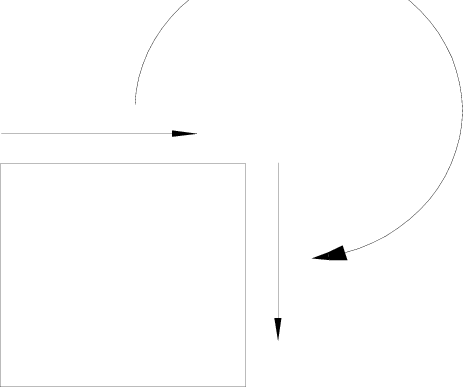
We will later give several extended examples of this with musical meter, modulation, and melodic form. However, it is best to initially illustrate the above with an example from the visual domain, to show that the musical examples are merely instances of the general process of perception - which in turn is merely an instance of our general theory of geometry. As an initial example, consider how the human visual system structures a square. In a sequence of psychological experiments, Leyton (1986b) and Leyton (1986c), we showed that human vision represents a square generatively, in much the same way that one draws it on a sheet of paper - i.e., drawing the sides sequentially around the square. Notice that this in fact involves a crucial transfer structure thus: The first side is generated by starting with a corner point, and applying translations to trace out the side, as shown in figure 2.
Next, this translational structure is transferred from one side to the next - rotationally around the square. In other words, there is transfer of translations by rotations. This is illustrated in figure 3. |