Therefore, the transfer structure is defined as the wreath product:

where Translations is the fiber group (corresponding to the side) and Rotations is the control group (transferring the side). This will now be defined rigorously, as follows:
The translation group (generating the side) will be denoted by the additive group  . The rotation group is
  , the cyclic group of order 4, which will be represented as

where  means clockwise rotation by
  degrees. We now construct a regular wreath product of these two groups. The construction will use the terminology of section 6.
The group  will be the control group,
  , and the control set will be the set
  of four side-positions around the square:
 | (8) |
The control action of  on the set
  will correspond to the clockwise rotation of the four side-positions onto each other.
The translation group  will be the fiber group,
  , and the fiber set will be the infinite line
  containing the finite side as a subset. This is mathematically and psychologically an important concept, as will be observed shortly. The fiber action of
  on the fiber set
  will be the obvious translation of the infinite line along itself.
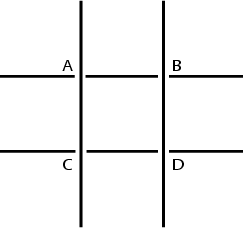
For each of the four members  of the control set
  , make a copy of the fiber action. Thus there will now be a set of four copies
  of the fiber set, called the fiber-set copies, indexed in the control set
  . These will be the four lines that contain the four finite sides as subsets. This structure is illustrated in figure 4.
Corresponding to the four fiber-set copies, there will be four copies 

 of the fiber group, called the fiber-group copies, also indexed in the control set
  . Each fiber-group copy (translation group) will act on its own ”personal” copy of the fiber set (infinite line). One can now define the regular wreath product:
![R wO Z4 = [Rc1× Rc2× Rc3× Rc4] Os Z4.](../graphic/Co2339x.gif) | (9) |