|
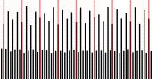
any significant differentiation whatsoever. In Fleischer (2002b) this phenomenon therefore was called mutual annihilation.
The analysis of the second part (measures 78-154) in figures 51 and 52 reveals great metric weights on the second and fourth beats as well. The isolated metric analysis of the string instruments in figure 53 again shows a complementary structure, since the highest layer is built upon the first and third beats of the measures. In contrast to this the isolated analysis of the wind instruments in figure 54 gains a less structured weight, nevertheless great metric weights on the second beat often can be found.
The latter we can observe within the isolated analysis of the first violins in figures 55 and 56 as well. The great metric weights on the second beats correspond to the rhythmic accentuation of this beat by placing half notes on it (see figure 57), the low metric weights on the first beats correspond to the tying together of the first beat of the measure with the last beat of the previous measure, such as in |