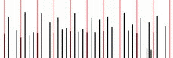
measures 84/85, 87/88 or 89/90.
3.5 Summary Second Symphony
Inner metric analysis of the first movement of Brahms’ Second Symphony suggests a segmentation of the exposition into three parts of very different regularity of the inner metric structure, which furthermore corresponds to a segmentation of the exposition regarding harmonic structure. Detailed investigations of the three segments enlightened the influence of hemiolas and syncopations on inner metric structure. Further peculiarities are concerned with regularities of the metric weight, which correspond to a different time signature as the notated one, such as the  instead of
  (figure 5) or
  instead of
  (figures 12, 15). Another peculiarity concerns those metric weights, which exhibit periodicities that allow no correspondence to any time signature (figures 22, 3). The coherent first part of the metric weight of the exposition (figure 4) answers Epstein’s question concerning the relation of down- and upbeat of the first two measures.
Inner metric analysis of the second movement enlightens a typical feature of the thematic material notated as  in all three segments, which consists in great metric weights on the second and fourth beats (figures 24, 25, 26) and corresponds to an observation in Frisch (1990) regarding the piano quintet. Frisch considers this phenomenon a typical characteristic in Brahms’ Œuvre. The mentioned lack of structural accents observed in the second movement in Epstein (1994) corresponds to a metric weight without a differentiation of the highest layer (figure 29). Furthermore a hidden relation between the two parts of different time signatures was detected (figure 35). The analysis of the third movement demonstrates the very different influence of syncopes on the inner metric structure depending on the context in comparison to the first movement. The analysis of the fourth movement