for which

, form a topological base of

. With this topology (the structures leading to this topology be implicitly assumed),

is called a
motivic gestalt space, for a score

the relative space

is called a
motivic gestalt space on 
. We denote the
 -neighborhood of a gestalt
in

by

and denote

, called the
multiplicity of 
, the number of motives in

in gestalt

.
Theorem (Buteau, 1998). If the pseudo-metric  is a metric for all
  , then the canonical maps
  , and
, and  are open continuous maps onto the quotients, and the topologies on
  and
and  are the quotient topologies.
Example. We exemplify the setup leading to a motivic topology. See Buteau and Mazzola (2000) for a more complete description. Consider the space  . We fix the parameters
  , and
, and  in a way which is standard in Mathematical Music Theory (Mazzola, 1990): For the pitch values, we select the usual gauge with
  , and the chromatic pitch set being parameterized by the integers, i.e.
  ,
,  , etc. Duration values are taken by the prescription that
  in the
  -coordinate corresponds to the literal mathematical value of
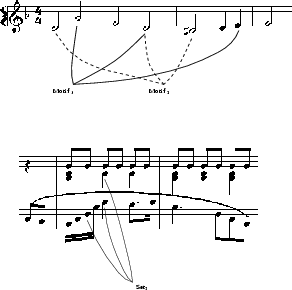
  duration. The first tone of a score is given onset value 0. Consider Figure 1.
We suppose that our score  contains only the eight notes from Bach’s Kunst der Fuge 8-tone Main Them as shown in Figure 1 top bars. First we have the set of the score’s notes:

We select the collection  of motives for the score
  as containing all motives with cardinality between 2 and 4. Therefore, the collection
  contains
  motives of cardinality 2,
  of cardinality 3, and
  of cardinality 4, which makes a total of 154 motives.
We consider two motives  and
and 
 from Figure 1. The abstract images of
  and
and  are
are  and
and  . The gestalt for the counterpoint paradigmatic group
  of
of  is the collection of all motives in
  such that their images through the mapping
  is one of the following four abstract motives:
  ,
,  ,
,  , or
, or  (corresponding respectively to the abstract motif
  , its inversion, its retrograde, and its inversion composed with the retrograde). Using the MeloTopRUBETTE for identifying the motives together, we get the following number of gestalts: there are 2 gestalts of motif cardinality 2, 5 of cardinality 3, and 18 of cardinality 4.